 how-to
How to Identify Asbestos in Electrical Panels Safely
Table of Contents
- Where Asbestos Hides in Electrical Panels and Switchboards
- Spotting an Older Switchboard and Meter Board
- What Asbestos Electrical Panel Backing Board Looks Like
- Labels, Dates and Building Age: Reading the Clues
- How to Test for Asbestos in Electrical Panels
- What to Do If You Find Asbestos in a Switchboard
- Asbestos Safety for Electricians Working on Older Panels
- Book a Licensed Switchboard Inspection Before You Renovate
- Frequently Asked Questions
Last Updated: November 2, 2026
Where Asbestos Hides in Electrical Panels and Switchboards
Learning how to identify asbestos in electrical panels starts with knowing exactly where to look. Asbestos in older switchboards usually sits in the backing board behind the wiring, in arc barriers between circuits, and in insulation around fuses and cabling. Treat every pre-1990 board as a suspected risk until proven otherwise.
Asbestos is a naturally occurring mineral fibre once used for its heat resistance and electrical insulation. In switchboards, that meant cement sheeting, arc chutes and woven flash guards.
The main hiding spots include:
- Backing boards: flat cement sheeting mounted behind the panel
- Arc barriers: dividers between fuse carriers and busbars
- Flash guards and fuse blankets: woven or millboard sheets
- Cable insulation: older cloth or felt wraps on wiring
- Meter board panels: the mounting board behind the meter
If your board was installed before 1990, treat these components as suspected asbestos until a sample is tested.
Spotting an Older Switchboard and Meter Board
Age is the strongest clue you have. Asbestos-containing materials were widely used in electrical equipment from the 1940s through to the late 1980s. A board installed before 1990 carries a real risk. Our switchboard upgrade guide explains when an old board should be replaced.
Older switchboards often show these signs:
- A dark brown or black backing board with a dimpled or textured surface
- Ceramic fuses rather than modern circuit breakers
- A timber or cement mounting board behind the meter
- Cloth-wrapped wiring instead of plastic-insulated cable
- A manufacturer label with an old product name and no modern standards mark
Check the meter board too. It often uses the same cement sheeting as the switchboard.
What Asbestos Electrical Panel Backing Board Looks Like
An asbestos electrical panel backing board is a flat sheet of cement-based material, usually dark brown, black or grey. The surface may be smooth, dimpled or stamped with a pattern. It sits behind the fuses and wiring, and it feels hard and brittle.
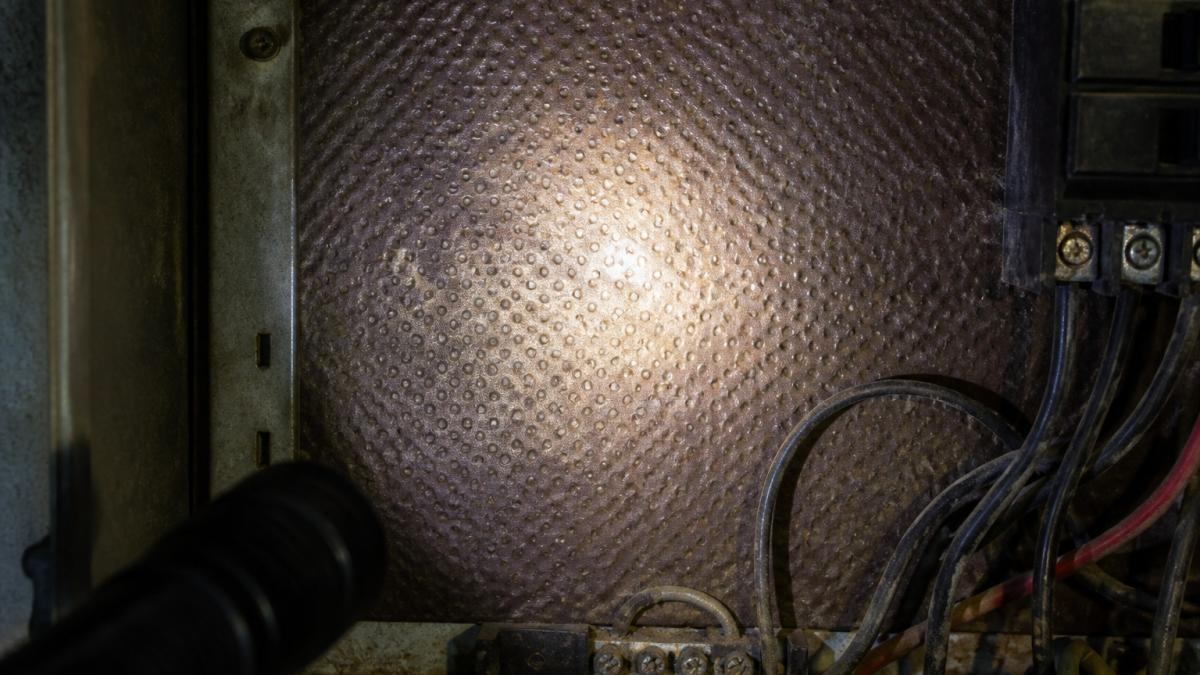
Look for these visual clues:
- Colour: dark brown, black or grey cement sheeting
- Texture: dimpled, stamped or smooth finish
- Edges: brittle and prone to chipping when disturbed
- Surface: a tar-like or bituminous coating on some boards
- Fibrous breaks: frayed edges where fibres may be visible
Looks alone cannot confirm asbestos. Only laboratory analysis confirms it.
Labels, Dates and Building Age: Reading the Clues
Manufacturer labels and installation dates tell you a lot, but they are not proof. A product name on the board can point to a known asbestos-containing brand. A missing label tells you nothing either way.
Work through these clues:
- Installation date: pre-1990 means higher risk, 1940-1990 is the peak period
- Building age: older homes are more likely to have original boards
- Manufacturer label: record the product name and any date stamp
- Standards marks: modern compliance marks suggest a newer, safer board
Cross-check the building age against the board. A 1960s home with its original meter board is a very different risk to a renovated property with a new panel.
How to Test for Asbestos in Electrical Panels
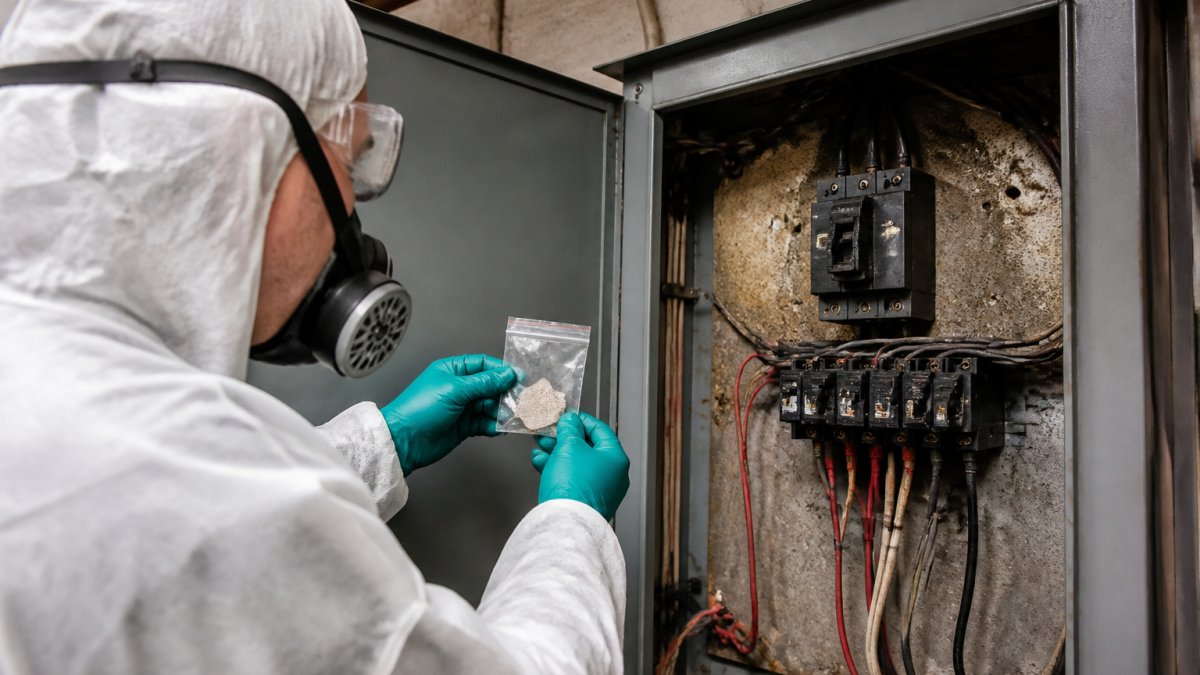
Testing is the only way to confirm asbestos. A licensed asbestos assessor takes a small sample and sends it to a laboratory for analysis. You should never take the sample yourself, because prising off a backing board creates both a shock risk and a fibre-release risk.
The testing process works like this:
- Stop work. Do not touch, drill or unscrew the panel. Treat the cover as live until an electrician isolates it.
- Book an assessor. Only a suitably licensed asbestos assessor should collect a sample. Check your state or territory work health and safety regulator's guidance on who can sample, as the rules differ between jurisdictions.
- Isolate and make safe. A licensed electrician isolates the panel before the assessor opens it. The assessor then uses wet methods, plastic sheeting and a P2 respirator to take a small piece with minimal disturbance.
- Laboratory analysis. The sample goes to a laboratory accredited for asbestos identification. The lab uses polarised light microscopy (PLM) to identify the fibre type, chrysotile, amosite, crocidolite or a mix, and reports the result as detected or not detected.
- Written report. You receive a clear result, the fibre type, the condition of the material, and next-step advice. Keep this report, electricians and removalists will ask for it before they touch the board.
Turnaround and interpretation. Laboratory turnaround times vary, so ask the lab for their current timeframe. A 'not detected' result means asbestos was not found in the sample submitted, it does not guarantee the whole board is clear, because asbestos can be present in one component (an arc barrier, a fuse blanket) and not another. A 'detected' result means the material must be managed as asbestos, even if it is in good condition.
The Asbestos Safety and Eradication Agency explains why sampling must be done by trained professionals. Disturbing a board can release airborne fibres that stay in the lungs. Appearance alone cannot confirm or rule out asbestos, a board that looks identical to a safe one may still contain fibres, and a board that looks suspicious may test clean.
Testing is the only way to confirm asbestos, and the process follows a set sequence.
| Step | What to do |
|---|---|
| 1 | Stop work; do not touch, drill or unscrew the panel |
| 2 | Book a suitably licensed asbestos assessor to collect a sample |
| 3 | Licensed electrician isolates panel; assessor samples with wet methods and P2 respirator |
| 4 | Laboratory accredited for asbestos identification analyses sample using PLM |
| 5 | Written report gives result, fibre type, condition and next-step advice |
What to Do If You Find Asbestos in a Switchboard
Confirmed asbestos changes the job. Do not drill, cut or remove the board yourself. Keep people away, and book a licensed professional. But on a switchboard you are managing two hazards at once, live electrical parts and airborne fibres, and the order you deal with them matters.
Follow these steps:
- Stop all work on the panel immediately. Do not switch anything on or off at the board if it is damaged or crumbling.
- Keep the area clear and stop anyone disturbing the board. Close the door to the room if you can, and keep children and pets away.
- Do not seal the panel itself. Sealing a live switchboard traps heat and creates a fire risk. Instead, isolate the room and restrict access.
- Label the risk so trades know before they start. A simple 'suspected asbestos, do not disturb' sign on the panel door is enough.
- Call a licensed electrician first if the panel is damaged, sparking, buzzing or hot. They isolate the supply so the asbestos risk can be managed safely. If there is smoke, fire or arcing, call emergency services.
- Then call a licensed asbestos assessor to confirm the extent and condition of the material and plan safe handling.
- Arrange removal or safe containment before any upgrade work. Any drilling, cutting or removal must be done under the relevant state or territory asbestos removal licence.
Containment and disposal. If removal is required, a licensed removalist will handle the material and its disposal. Your local council or state environment regulator can tell you which facilities accept asbestos waste in your area.
Watch out: drilling into a backing board is the most common way homeowners release fibres. One hole can send fibres into the air. The same drill bit can also contact live parts behind the board.
Asbestos Safety for Electricians Working on Older Panels
Electricians face two hazards at once on older boards: live electrical parts and airborne fibres. Both can hurt you. Treat every pre-1990 panel as a suspected asbestos board until tested.
Safety basics for the trade:
- Isolate power before any inspection
- Avoid power tools on suspect backing boards
Asbestos safety for electricians means knowing when to stop. If a panel is damaged or crumbling, step back and call an asbestos assessor. For suspect boards, fault finding and repairs support is available rather than working on hazardous panels yourself.
Book a Licensed Switchboard Inspection Before You Renovate
Renovation is when hidden asbestos becomes a real problem. Old boards get pulled out, walls come down, and fibres go airborne. A licensed inspection before work starts removes the guesswork.
A pre-renovation check can cover the age and condition of the switchboard and meter board, and suspected asbestos components. Our renovation electrical guide explains what the inspection involves and why it matters.
Do not let a renovation uncover a hazard mid-job. A renovation electrician can inspect and handle older switchboards before work starts. Book the inspection first.
Identifying asbestos in an electrical panel is a job for trained eyes and, where needed, a laboratory. Guessing puts your health and your home at risk. BPE Solutions is a licensed, insured and owner-operated electrical business, and the person who quotes your job does the work. We provide a written price before any work starts, and offer 24/7 emergency support. Get started with BPE Solutions and book a safe switchboard inspection before your next renovation.
Frequently Asked Questions
What does asbestos look like in an electrical panel?
Asbestos in an electrical panel usually appears as a backing board or arc barrier behind the wiring. It is often dark brown or black, with a dimpled, smooth or cement-like surface. Older boards may look fibrous or brittle at the edges. Because asbestos electrical panels can resemble modern cement sheeting, visual identification alone is not reliable. A licensed asbestos assessor or electrician should confirm any suspected material before it is disturbed.
Can you identify asbestos by looking at it?
No. Visual identification can only flag a suspicion, not confirm it. Many asbestos-containing materials look identical to safe alternatives, and the only definitive method is laboratory analysis of a sample taken by a trained professional. If your switchboard was installed before 1990, treat any backing board or arc barrier as suspected asbestos until testing proves otherwise.
Is it safe to open an electrical panel if you suspect asbestos?
Do not open it. Opening a panel can release airborne fibres and also exposes you to live electrical parts. Switch off power at the main switch only if it is safe to do so, keep the panel closed, and contact a licensed electrician or asbestos assessor. If the panel is damaged or the board is crumbling, restrict access to the area and arrange a professional assessment before any work begins.
What should you do if you find asbestos in a switchboard?
Stop work, avoid disturbing the material, and do not attempt removal yourself. Engage a licensed asbestos assessor to test and confirm the material, then follow their advice on safe handling and removal. For switchboard upgrades or renovations, a licensed electrician and asbestos removalist should coordinate the job so the asbestos is removed or encapsulated before electrical work starts.